

Table of Contents
- Why T-Shirt Quality Matters More Than the Price Tag
- Start With High-Quality T-Shirt Fabric: Fiber, Weight, and Knit
- T-Shirt Stitching and Construction: Where Cheap Tees Give Themselves Away
- How to Check T-Shirt Quality in Store: A 10-Point Inspection
- How to Tell If a Printed Shirt Is Good Quality
- Wash-Test Results: What Actually Happens After 20 Laundry Cycles
- Matching Quality to Price and Intended Use
- Conclusion
- Frequently Asked Questions
Last Updated: October 18, 2026
Why T-Shirt Quality Matters More Than the Price Tag
Learning how to tell if a t-shirt is good quality starts with one honest fact: price tells you almost nothing.
The real difference sits in the fabric, the stitching, and the construction. Those three things decide whether a tee survives twenty laundry cycles or falls apart after five.
Below, we'll show you exactly how to judge all three, using a simple in-store inspection you can run in under two minutes.
Start With High-Quality T-Shirt Fabric: Fiber, Weight, and Knit
High-quality T-shirt fabric is dense, tightly knit, and made from long cotton fibers that resist pilling and distortion. If the cloth is weak, no amount of good stitching will save the shirt.
Here's what to look at first:
- Fiber content: 100% cotton is the benchmark for breathability and softness. Blends add durability or stretch but change how the shirt feels and ages.
- Fiber length: Long-staple and ring-spun cotton create a smoother, stronger yarn. Short fibers shed and pill faster.
- Knit type: Jersey knit is the standard for tees. A tighter, denser knit blocks light and holds its shape.
Run your hand across the fabric. It should feel substantial, not slippery or papery.
Reading Fabric Weight and GSM Without Getting Fooled
Fabric weight is the single most useful spec on a t-shirt, and most shoppers ignore it. GSM (grams per square meter) measures how much fabric sits in a given area; higher GSM means heavier, denser cloth.
Here's a rough guide to what the numbers mean:
| GSM Range | Weight Class | What It Feels Like |
|---|---|---|
| 120-150 | Lightweight | Thin, semi-sheer, best for layering |
| 150-180 | Midweight | Standard retail tee, decent but not dense |
| 180-220 | Heavyweight | Substantial, holds shape, resists show-through |
| 220+ | Ultra-heavyweight | Structured, premium feel, slower to wear out |
A heavyweight cotton tee in the 180-220 GSM range is the sweet spot for daily wear. It drapes well, hides the undershirt, and survives repeated laundering.

Fiber Blends and Care Labels: What Each One Costs You
The care label is a contract. It tells you what the shirt is made of and how it will behave over time. Read it before you buy.
- 100% preshrunk cotton: Soft, breathable, minimal shrinkage if preshrunk. Wrinkles easily.
- Cotton/polyester blend: More wrinkle-resistant and durable, but less breathable and more prone to pilling.
- Cotton/spandex: Adds stretch and recovery, which helps shape retention. Too much spandex and the shirt feels synthetic.
A common mistake is assuming "100% cotton" always means better, it means better breathability. For shape retention, a small amount of spandex helps. Match the blend to how you'll wear the shirt.
T-Shirt Stitching and Construction: Where Cheap Tees Give Themselves Away
T-shirt stitching and construction reveal quality faster than any label. Turn the shirt inside out. This is where cheap tees give themselves away, and it takes about thirty seconds to spot the difference.
Look for these construction signals:
- Double-needle stitching on the collar, sleeves, and hem. Two rows of parallel stitches hold up far better than a single row.
- Taped neck and shoulders. A strip of fabric tape reinforces the seams that take the most stress when you pull a shirt on.
- Flat-locked or reinforced side seams. These lie flat against the body and resist splitting.
Check the button attachment if the shirt has one. A button sewn with a shank and reinforced thread won't pop off in the wash.
How to Check T-Shirt Quality in Store: A 10-Point Inspection
Knowing how to check t-shirt quality in store comes down to a repeatable routine with clear pass/fail cues. Run this ten-point check on any tee before you buy, it takes about ninety seconds once you've done it a few times and works on any brand at any price point.
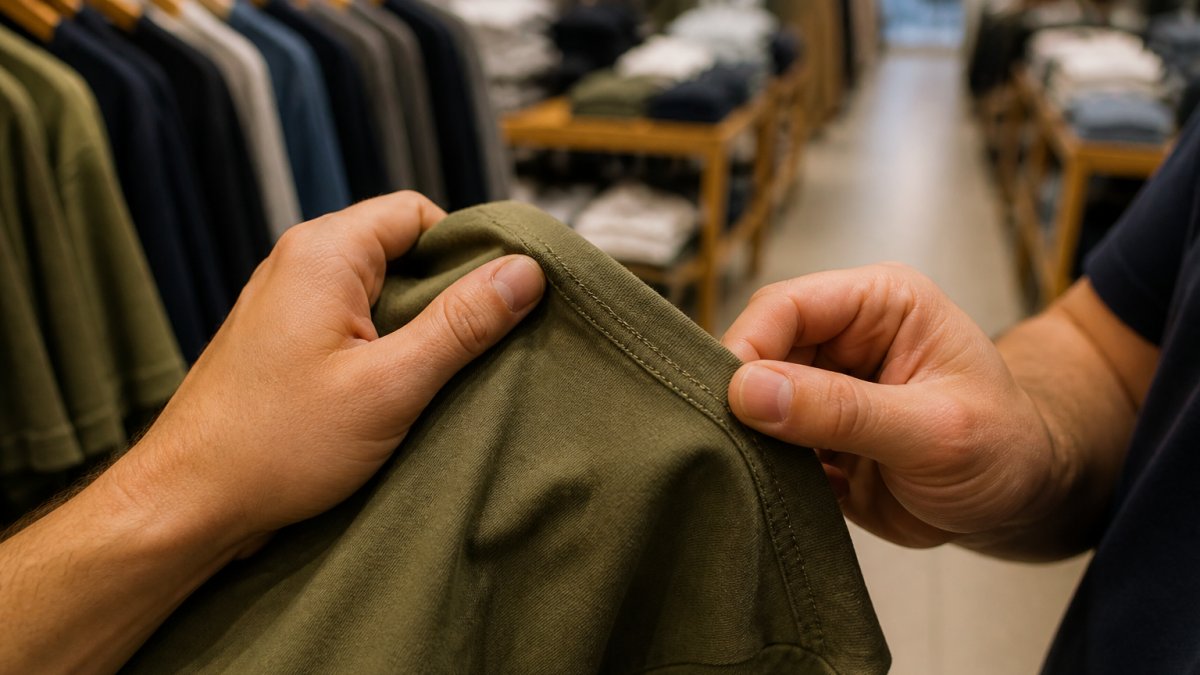
- Read the fiber content and care label (10 seconds). Pass: the blend matches how you plan to wear the shirt, and the care instructions are realistic for your routine. Fail: the label is missing, illegible, or demands dry cleaning on a tee you intend to wash weekly.
- Check the stated fabric weight (5 seconds). Pass: a GSM or ounce-per-square-yard figure is printed or available, and it falls in the 180-220 GSM range for a standalone everyday tee. Fail: no weight is disclosed at all, which usually signals a lightweight blank.
- Hold it up to the light (5 seconds). Pass: you cannot clearly see your hand through a single layer. Fail: fingers are visible through the cloth, the shirt is too sheer for standalone wear regardless of the label.
- Stretch the fabric sideways across the chest (10 seconds). Pass: it springs back to its original width within a second or two. Fail: it stays stretched or ripples, which points to weak knit recovery.
- Turn it inside out and inspect the shoulder seams (15 seconds). Pass: a strip of fabric tape covers the seam, and the stitching is tight and even. Fail: a bare, single row of loose stitches, this is the number one failure point on cheap tees.
- Check the neckline (10 seconds). Pass: ribbed collar with a double-needle or taped finish that lies flat. Fail: a thin, single-stitch collar that already looks wavy on the hanger.
- Pull gently on the hem (10 seconds). Pass: the edge stays flat and the stitches hold. Fail: loose threads, a wavy edge, or a single row of stitching that separates under light tension.
- Rub the surface firmly with your palm (10 seconds). Pass: little to no fuzz transfers to your hand. Fail: visible fiber shedding, which signals short-staple yarn and future pilling.
- Lay it flat and sight down the side seams (10 seconds). Pass: the seams run straight from armpit to hem. Fail: seams that twist or curve, a sign of unstable knitting that worsens after washing.
- Check the print if there is one (15 seconds). Pass: crisp edges, even coverage, and a print that flexes when you stretch the fabric. Fail: blurry edges, ink that feels like a stiff sticker, or color that rubs off on your finger, an under-cured print.
This checklist works for any brand, any price point. It's the same set of checks we apply to the heavyweight cotton tees we print on, because a crisp design is worthless on a shirt that won't last.
Heavyweight Unisex Crewneck T-shirt | Gildan® 5000 →
How to Tell If a Printed Shirt Is Good Quality
Knowing how to tell if a printed shirt is good quality means judging the print and the blank together. A great design on a weak shirt is still a weak shirt.
Start with the print itself:
- Crisp edges. Lines should be sharp, with no blurring or bleeding into the fabric.
- True color. The color on the shirt should match what you saw online or on the sample.
- Even coverage. No thin patches, no ink sitting on top of the cloth like a sticker.
Then check the blank underneath. Run the ten-point inspection above on the shirt carrying the print. A print can't outlast its fabric.
Wash-Test Results: What Actually Happens After 20 Laundry Cycles
The wash test is the only real proof, a shirt can pass every in-store check and still fail in the laundry. Here is a repeatable home protocol for comparing two shirts, plus the failure modes to watch for.
A simple 20-cycle home protocol. Wash each test shirt separately in cold water on a normal cycle with measured detergent, tumble dry on low, and turn graphic tees inside out.
What to measure and what counts as a failure.
- Shrinkage: more than about 5% in body length or chest width after the first wash is a warning sign; continued shrinkage through cycle 20 points to fabric that was not preshrunk.
- Seam twist: the side seam should stay within roughly half an inch of vertical when the shirt is laid flat. Visible twisting means the knit was unstable before cutting.
- Pilling: check the underarm, side, and back areas under raking light. Light surface fuzz is normal; distinct pills that change the hand-feel are a fail.
| What You See | What It Means | Root Cause |
|---|---|---|
| Pilling on the surface | Short fibers breaking loose | Low-quality yarn |
| Twisted side seams | Fabric distortion after shrinking | Poor knit stability |
| Faded print | Ink broke down or was not cured | Weak print process |
| Shrunken length | Fiber shrinkage not controlled | No preshrinking |
| Stretched neckline | Weak ribbing or single-stitch collar | Cheap collar construction |
| Loose threads at hems | Weak finishing | Single-needle stitching |
Wash cold, tumble dry low, and turn graphic tees inside out to extend their life. Those habits slow wear, but they cannot fix a blank that was never built to last.
Matching Quality to Price and Intended Use
Quality is relative to what you need the shirt to do. A gym tee doesn't need the same build as a graphic tee you'll wear weekly for years. Match the construction to the job.
- Everyday wear: Heavyweight cotton, 180-220 GSM, double-needle seams.
- Layering: Lighter weight is fine, but check for opacity.
- Graphic and statement tees: Dense blank plus a properly cured print.
Think about cost per wear, not sticker price. A durable tee that lasts three years beats three cheap ones that fail in months. That's the standard we hold at Unique Designs, where every design is printed on premium heavyweight cotton built for the long haul.
Conclusion
The challenge isn't finding a cheap t-shirt. It's finding one that still looks good after a year of washing.
At Unique Designs, we print on premium heavyweight cotton because the blank matters as much as the design. Our tees feature taped neck and shoulders, double-needle hems, and crisp, true-color prints that hold up wash after wash.
Shop the collection and wear a shirt that's made to last.
Frequently Asked Questions
What makes a t-shirt high quality?
Four things separate a good tee from a disposable one: fabric, construction, print, and fit. Look for 100% cotton or a cotton-rich blend with a tight jersey knit, a fabric weight around 5 to 6.5 oz (roughly 170 to 220 GSM) for everyday wear, and dense stitching at the collar, shoulders, and hems. Double-needle hems and taped neck seams are visible proof of extra reinforcement. A quality t-shirt should also hold its shape and color after repeated laundering. If the collar ripples or the print cracks within a few washes, the construction was never there to begin with.
How can you tell if a printed t-shirt is good quality?
Run your thumb across the print. A quality print sits flush with the fabric, has crisp edges, and shows no visible cracking or flaking. Stretch the fabric gently under the graphic: if the ink cracks along the stretch lines, it will fail in the wash. Check that colors are consistent across the whole design with no thin, washed-out patches. Also look at the print's placement relative to the seams; a crooked or off-center graphic signals rushed production. Properly cured prints survive dozens of cold-water washes without fading, peeling, or losing sharpness at the edges.
How can you tell if a t-shirt will shrink or lose its shape?
Check the care label first. Preshrunk cotton, often labeled as preshrunk jersey knit, has already been through a shrinkage process and will move far less than untreated cotton. Next, look at the collar: a ribbed collar with elastane or a reinforced double-needle neckline holds its shape, while a thin single-stitch collar will stretch out fast. Hold the shirt up to the light and check the side seams for puckering or twisting. Finally, check the hem; a wavy or curled hem before you even wash it is a sign the fabric was cut or sewn under tension.
What should I check when buying a t-shirt online?
Since you cannot touch the fabric, rely on the listing details. Look for a stated fabric weight in ounces or GSM, a named fiber composition, and construction notes like taped neck and shoulders, double-needle hems, and seamless collars. Read the size guide for actual garment measurements, not just S/M/L labels, and compare them to a tee you already own. Check the return policy before ordering. Reviews that mention shrinkage, print cracking, or collar stretching after washing are the most useful signal, because they describe what the shirt does after real use, not how it looked in the photo.
